Automated Build & Test
Catch issues early with repeatable quality checks.


SNWN Tech Solution delivers enterprise CI/CD pipeline engineering and delivery automation services to eliminate manual deployment risks. We architect high-throughput automated build, test, and GitOps release workflows, empowering engineering teams to accelerate deployment frequency, enforce quality gates, prevent downtime, and achieve scalable, secure, and continuous production software delivery.
Catch issues early with repeatable quality checks.
Promote changes consistently across environments.
Reduce release risk with canary and blue-green rollout patterns.
Delivery challenges
Engineering teams move faster when their delivery process is visible, repeatable, and easy to improve.
Releases are infrequent, stressful events requiring off-hours maintenance windows and massive operational oversight.
Frequent environment drift between development, staging, and production causes unpredictable production outages.
Long-lived branches result in complex merge conflicts, broken master builds, and delayed delivery timelines.
Manual server updates via SSH script execution, lacking auditable revision history or automated rollback capabilities.
Engineering capability map
Connect the right engineering practices, automation, and platform tools to the way your teams deliver software.
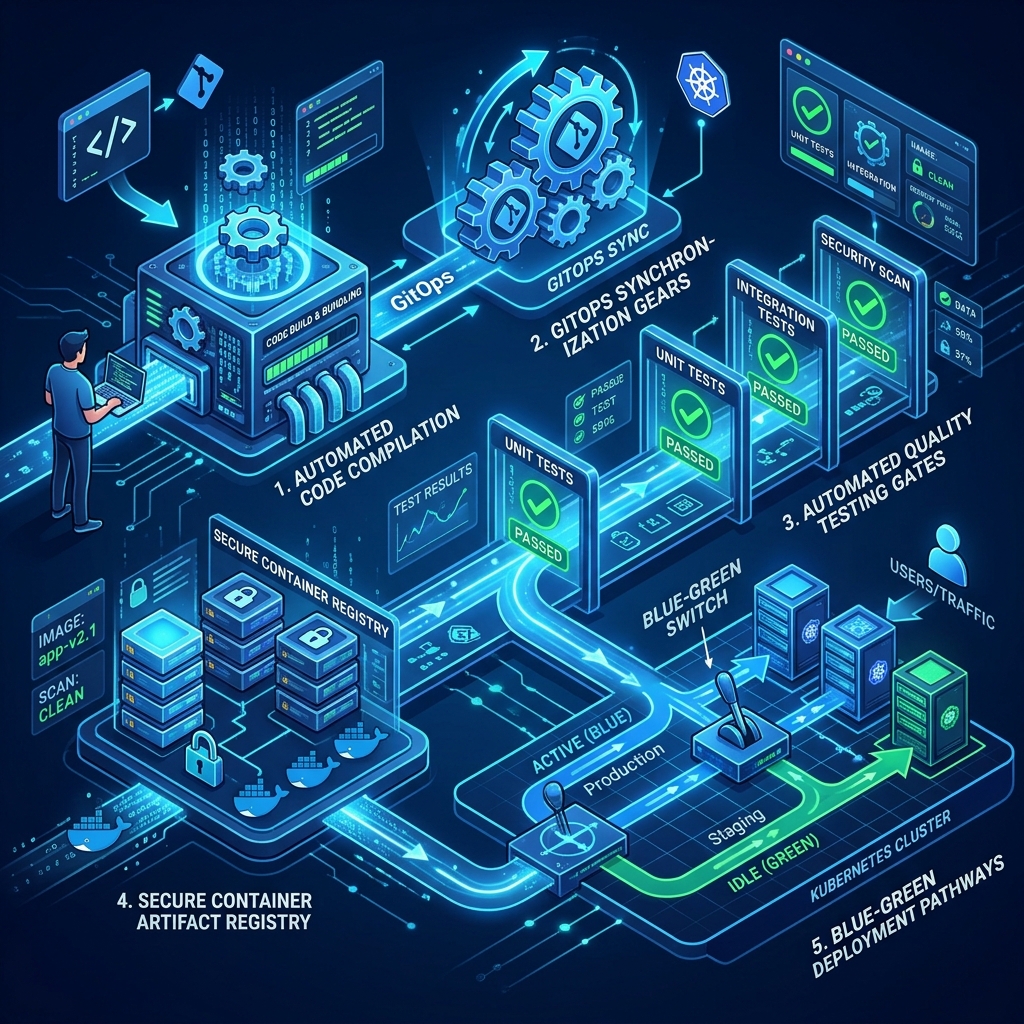
Architect fast, parallelized CI build pipelines integrated with SAST scanning, SonarQube quality gates, and hardened OCI container image compilation.
Implement ArgoCD and Flux GitOps delivery engines with automated Canary analysis and Blue/Green traffic shifting for zero-downtime production releases.
Embed headless Playwright, Cypress, REST/gRPC contract verification, and k6 load testing gates directly into pull request and release pipelines.
Manage software supply chain integrity using JFrog Artifactory, AWS ECR, cryptographic Cosign image signing, and automated SBOM vulnerability scanning.
Engineer unified deployment pipelines that release workloads seamlessly across AWS, Azure, Google Cloud, and on-premises Kubernetes clusters without lock-in.
Applied engineering workflows
See how platform engineering improvements can reduce friction in the everyday work of building and operating software.
Select a use case to view its scenario, outcome and delivery steps.
Transition smoothly from high risk monthly releases into automated, multi-daily production deployments supported by comprehensive audit trails and verifiable telemetry.
Releases are infrequent, stressful events requiring off-hours maintenance windows and massive operational oversight.
Architect fast, parallelized CI build pipelines integrated with SAST scanning, SonarQube quality gates, and hardened OCI container image compilation.
Transition smoothly from high risk monthly releases into automated, multi-daily production deployments supported by comprehensive audit trails and verifiable telemetry.
Comprehensive review of existing repository structures, branching models, build speeds, testing coverage, and deployment pain points.
Implement advanced Blue/Green, Canary, and progressive deployment routing patterns that completely protect end-user experience throughout active production application updates.
Frequent environment drift between development, staging, and production causes unpredictable production outages.
Implement ArgoCD and Flux GitOps delivery engines with automated Canary analysis and Blue/Green traffic shifting for zero-downtime production releases.
Implement advanced Blue/Green, Canary, and progressive deployment routing patterns that completely protect end-user experience throughout active production application updates.
Establishing standardized Git branching strategies (Trunk-Based Development) and defining immutable container build specs across microservices.
Enforce mandatory automated unit, integration, UI, and security testing gates that instantly block regression defects and vulnerable dependencies from merging.
Long-lived branches result in complex merge conflicts, broken master builds, and delayed delivery timelines.
Embed headless Playwright, Cypress, REST/gRPC contract verification, and k6 load testing gates directly into pull request and release pipelines.
Enforce mandatory automated unit, integration, UI, and security testing gates that instantly block regression defects and vulnerable dependencies from merging.
Constructing automated integration, unit testing, SAST scanning, and artifact packaging modules within your chosen enterprise CI engine.
Delivery approach
We work in clear stages, validate changes with your team, and prepare the workflow for ongoing ownership.
Select a step to explore its activities, buyer inputs and outputs.
Comprehensive review of existing repository structures, branching models, build speeds, testing coverage, and deployment pain points.
Establishing standardized Git branching strategies (Trunk-Based Development) and defining immutable container build specs across microservices.
Constructing automated integration, unit testing, SAST scanning, and artifact packaging modules within your chosen enterprise CI engine.
Configuring continuous delivery controllers (e.g., ArgoCD) to automate target environment deployments with progressive rollout protection.
Parallelizing execution tasks, fine-tuning build caches, delivering technical documentation, and onboarding your internal engineering teams.
Ownership, guardrails & operations
Good engineering workflows make the paved path easy to use while keeping security, reliability, and ownership visible.
Before delivery starts, we agree which repositories, cloud accounts, clusters, pipelines, and environments are in scope, along with change controls, access needs, and the teams responsible for ongoing operations.
Make common engineering tasks easier to start and repeat.
Build review, access, and policy checks into the workflow.
Keep service owners, support paths, and follow-up work clear.
Engineering readiness checklist
Use these checks to prepare your team, repositories, environments, and delivery goals for a focused engineering review.
Common questions
Clear answers to help your team plan the right next step.
Yes. While microservices naturally align with continuous delivery, monolithic architectures gain immense value from automated build caching, test parallelization, and zero-downtime rolling deployment strategies. SNWN specializes in restructuring monolithic release cycles into efficient, reliable pipelines.
Trunk-Based Development is a strategy where software engineers merge small, frequent updates into a core shared branch ("trunk") rather than maintaining long-lived feature branches. Supported by automated testing gates, this approach minimizes merge conflicts, accelerates feedback loops, and enables true continuous integration.
Blue/Green deployments maintain two identical production environments, switching live user traffic instantly once the new version is validated. Canary deployments route a small percentage of real user traffic to the new release to monitor telemetry and error rates before full promotion, preventing systemic outages.
With GitOps, every change to production infrastructure or application configuration is made via declarative Git pull requests. This provides an immutable, cryptographically auditable commit history with automated rollback capabilities, satisfying strict regulatory standards.