preloader

Energy & Utilities Corporate IT Solutions

Reliable Cloud Systems for Energy & Utilities

Connect asset records, field teams, and customer services with continuity in mind.

Connected Field, Asset & Billing Systems

Integrate work-order management, ERP, customer portals, and inspection records so field updates flow cleanly into corporate systems.

Resilient Cloud & Hybrid Hosting

Operate high-availability cloud and hybrid environments for customer self-service portals, outage status pages, and corporate workloads.

Disciplined Continuity & Security Posture

Enforce strict identity governance, IT network segmentation, and tested backup restoration routines across business systems.

Industry Realities

Enterprise IT Pressures in Energy & Utility Operations

Energy and utility companies manage long-lived physical assets alongside aging corporate software. IT leaders must modernize customer and field-force applications while maintaining strict separation from operational technology (OT) environments.

Business growth
Fragmented systems
Operational strain
Pressure point 01

Disconnected Field Inspection, Work-Order & ERP Platforms

Field crews record maintenance inspections, meter replacements, or contractor work in mobile apps or forms that do not synchronize cleanly with corporate ERP and asset records.

Operational impact
Dispatchers and finance teams manually reconcile completed work orders, delaying contractor invoicing and maintenance history updates.
How SNWN responds
We build resilient API integrations and digital intake workflows that validate and sync field reports into enterprise asset and ERP databases.

Pressure point 02

Customer Portals Under Strain During Weather or Billing Events

Account portals, usage dashboards, and service-status pages hosted on rigid legacy infrastructure can slow down when severe weather or billing cycles drive concurrent traffic.

Operational impact
When digital self-service slows down, call centers absorb avoidable inquiry volume during high-pressure operational windows.
How SNWN responds
We decouple customer web portals and status pages onto scalable cloud architectures backed by CDN caching and read-optimized data stores.
Pressure point 03

Aging On-Premises Servers & Complex Hybrid Environments

Corporate applications accumulated over decades often run on aging virtual machines with inconsistent patching, manual deployment steps, and unclear dependency maps.

Operational impact
Hardware refreshes become risky, and maintaining legacy server environments consumes disproportionate IT engineering time.
How SNWN responds
We inventory application dependencies, modernize hosting across public or private cloud platforms, and standardize provisioning and patching.
Pressure point 04

Fragmented Operational & Sustainability Reporting Data

Data needed for executive operations reviews, asset maintenance tracking, and environmental/emissions reporting sits scattered across multiple databases and spreadsheets.

Operational impact
Analysts spend weeks gathering and validating spreadsheets rather than analyzing operational trends.
How SNWN responds
We build automated data pipelines into governed analytics repositories with clear data lineage and role-based BI dashboards.

How SNWN Helps

Energy & Utilities IT Capability Map

Our work centers on the corporate IT, cloud, integration, data, and security layers that support energy and utility businesses.

ApplicationsCustomer and business tools
IntegrationAPIs and workflows
Cloud platformSecure foundations
Reliable operationsObserve and improve
Capability 01

Energy Cloud Migration & Hybrid Infrastructure

Modernize corporate data centers, customer portals, and business applications across public cloud or private/hybrid virtualized platforms.

Practical deliverables

  • Workload assessment and phased migration planning for corporate and customer-facing applications
  • Public cloud architectures on AWS, Microsoft Azure, or Google Cloud with multi-zone availability
  • Private and hybrid cloud infrastructure support across VMware, Nutanix, and OpenStack environments
  • Standardized OS patching, monitoring telemetry, and infrastructure-as-code templates
Capability 02

Utility Systems Integration & Field Workflow Digitization

Connect work-order dispatching, contractor portals, CRM, and ERP systems while replacing paper-based field and administrative forms.

Practical deliverables

  • API middleware connecting field-service applications, asset registries, CRM, and financial ERP platforms
  • Digital inspection checklists, contractor completion forms, and automated approval workflows
  • Offline-tolerant queue and retry patterns for mobile field data synchronization
  • Automated validation and exception routing for billing and meter-to-cash administrative data
Capability 03

Operational, Asset & Executive Data Analytics

Consolidate enterprise data from maintenance logs, commercial platforms, and regional operations into structured BI reporting.

Practical deliverables

  • Automated ETL/ELT pipelines ingesting work-order, customer service, and financial datasets
  • Data quality validation, schema standardization, and historical archiving
  • Executive and operational dashboards tracking maintenance backlog, ticket resolution, and cost trends
  • Role-scoped access controls for internal departments and external reporting preparation
Capability 04

IT Security, Identity Governance & Business Continuity

Harden corporate IT environments, enforce strict identity boundaries for employees and contractors, and verify disaster-recovery readiness.

Practical deliverables

  • Role-based access control (RBAC), SSO, and MFA across corporate cloud and application portals
  • Time-bound, least-privilege access governance for third-party contractors and field vendors
  • Network segmentation between public web channels, corporate IT systems, and restricted zones
  • Immutable backup vaults and scheduled disaster-recovery restoration drills

Practical Workflows

Representative Energy & Utility IT Use Cases

Examples of how SNWN structures engineering projects to improve reliability and data flow across utility and energy business operations.

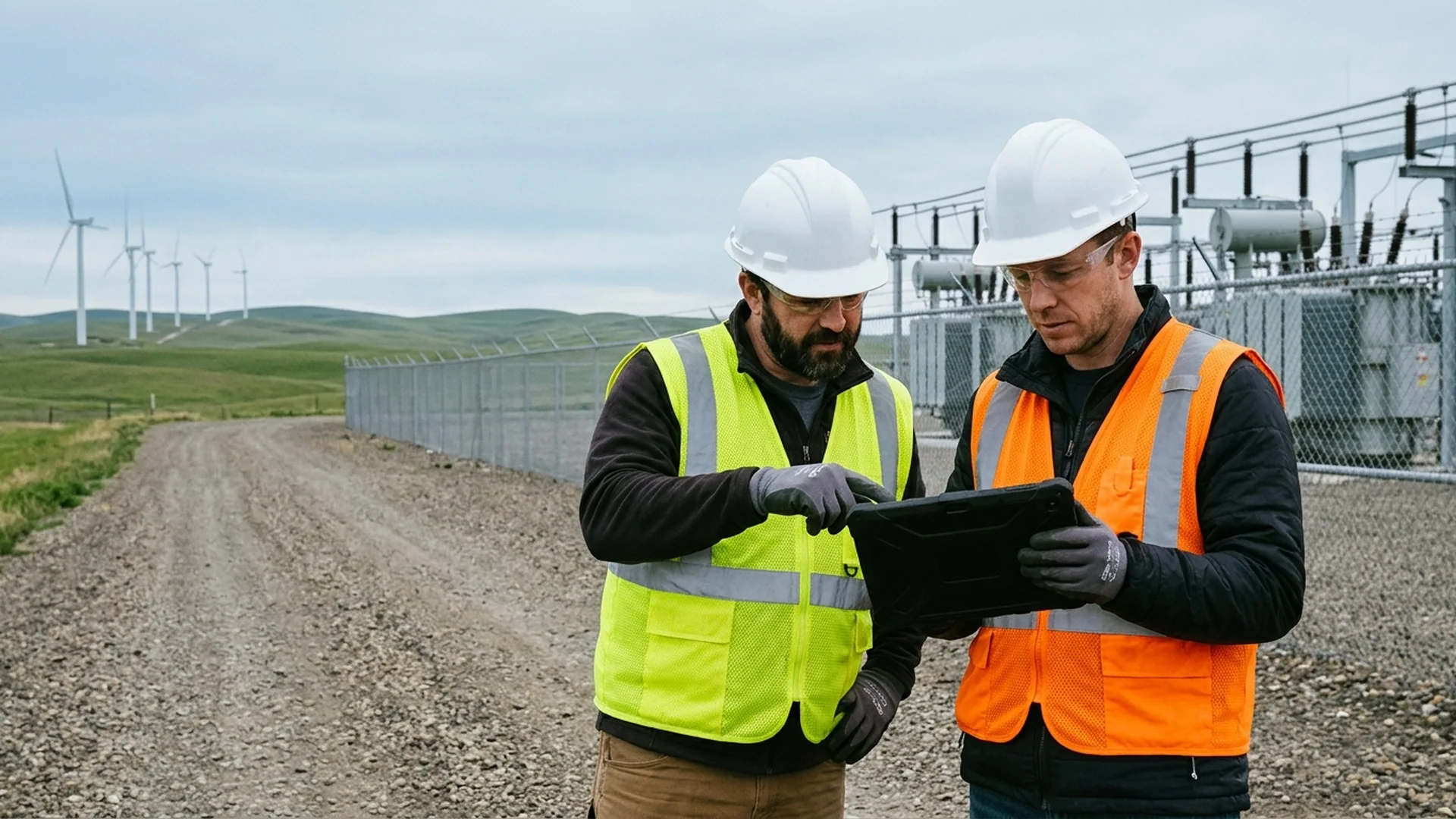
Utility engineers inspecting solar assets with a field tablet.
Built around your sectorEngineering For,
Energy & Utilities

Select a use case to view its scenario, outcome and delivery steps.

Use Case 01

Digitizing Field Inspection & Contractor Work-Order Submissions

Related: Process Digitization →

Field technicians and external maintenance contractors submit inspection checklists and job-completion records via PDFs and spreadsheets, delaying asset record updates and invoice verification.

OutcomeEliminates manual re-keying of field reports, accelerates maintenance record accuracy, and gives supervisors clear audit visibility.
  1. Assess

    Document inspection fields, required photo/attachment metadata, supervisor approval rules, and target ERP/asset database schemas.

  2. Plan

    Design a mobile-ready digital submission workflow with role-based contractor logins and automated field validation.

  3. Integrate

    Connect approved completion records via API to the work-order and ERP systems so maintenance histories update automatically.

  4. Operate

    Monitor submission queues, audit approval timestamps, and track contractor turnaround times in BI dashboards.

Use Case 02

Decoupling & Scaling a Customer Account and Service-Status Portal

Related: AWS Cloud →

A utility or energy retailer wants its customer web portal and outage/service-status updates to remain fast during high-traffic events without straining internal billing databases.

OutcomeKeeps digital customer channels responsive during high-demand periods while shielding core back-office databases from traffic surges.
  1. Assess

    Analyze portal traffic spikes, static versus dynamic content ratios, and dependencies on internal billing and CRM databases.

  2. Plan

    Architect a cloud-hosted portal tier with edge caching for status maps/announcements and a synchronized read replica for account views.

  3. Integrate

    Implement queue-backed API middleware so customer service requests and payment notifications buffer safely during peak load.

  4. Operate

    Run load tests ahead of seasonal weather peaks and monitor portal availability and API queue depth continuously.

Use Case 03

Consolidating Multi-Site Operational & Maintenance Data for Reporting

Related: Data & Analytics BI, Reporting →

An energy operator with multiple regional sites needs to combine work-order completion metrics, equipment downtime logs, and procurement spend into a unified reporting layer.

OutcomeReplaces manual monthly spreadsheet assembly with consistent, up-to-date operational visibility across sites.
  1. Assess

    Catalog regional databases, spreadsheet templates, refresh schedules, and reporting KPI definitions.

  2. Plan

    Define a centralized cloud data model with standardized site, asset-category, and cost-center dimensions.

  3. Integrate

    Build automated ingestion pipelines with data-quality checks that flag missing or malformed site records.

  4. Operate

    Deliver role-based operational dashboards and scheduled summary reports for regional and executive leadership.

Delivery Methodology

How We Deliver Energy & Utility IT Projects

We execute corporate IT, cloud, and integration projects with strict respect for operational boundaries, change-control windows, and security governance.

Select a step to explore its activities, buyer inputs and outputs.

  1. Step 01

    Boundary Definition & Enterprise IT Discovery

    We map the corporate applications, databases, and integrations in scope while establishing clear boundaries away from physical OT/control systems.

    Engineering Activities

    • Inventory application topology, hosting infrastructure, and integration interfaces
    • Confirm strict architectural separation between corporate IT workloads and any operational technology (OT) networks
    • Identify manual workflows, brittle scripts, and backup or availability gaps

    Buyer Inputs

    • Enterprise architecture diagrams and network boundary policies
    • Input from IT, security, and business-unit stakeholders

    Concrete Outputs

    • Discovery assessment and architectural boundary map
    • Phased modernization or integration backlog
  2. Step 02

    Resilient Architecture & Integration Design

    We design the target cloud environment, integration middleware, or data pipeline to meet your availability and security standards.

    Engineering Activities

    • Define cloud network segmentation, IAM roles, encryption keys, and backup policies
    • Specify API data contracts, queue buffering, and error-reconciliation workflows
    • Establish change-management checkpoints and rollback plans

    Buyer Inputs

    • Architecture and information-security review sign-off
    • Approval of maintenance windows and operational acceptance criteria

    Concrete Outputs

    • Detailed technical design specification
    • Implementation and cutover rehearsal plan
  3. Step 03

    Staging Implementation & Validation

    We build and test all infrastructure templates, API connectors, and workflows in isolated non-production environments.

    Engineering Activities

    • Provision cloud or virtualized infrastructure via version-controlled code
    • Develop and test integrations and digital forms using staging datasets
    • Execute load testing, failover checks, and backup restoration rehearsals

    Buyer Inputs

    • Sandbox endpoints and representative test datasets
    • Participation from operational users during UAT

    Concrete Outputs

    • Validated staging environment and test results
    • Production deployment and rollback runbooks
  4. Step 04

    Controlled Cutover & Operational Verification

    We deploy to production during approved maintenance windows and verify end-to-end system health.

    Engineering Activities

    • Execute phased production rollout or migration checklist
    • Verify portal responsiveness, API data synchronization, and centralized log capture
    • Provide dedicated engineering support through initial operational cycles

    Buyer Inputs

    • Change-advisory sign-off for production release
    • Business-owner verification of live workflows

    Concrete Outputs

    • Production workload or integration live and monitored
    • Post-cutover verification report
  5. Step 05

    Documentation Handover or Ongoing IT Operations

    We transition complete runbooks and repositories to your internal IT staff or continue supporting the environment under a managed scope.

    Engineering Activities

    • Deliver as-built architecture diagrams, code repositories, and incident playbooks
    • Conduct walkthrough sessions with your internal IT and support teams
    • Provide ongoing patching, backup verification, and cloud monitoring if engaged

    Buyer Inputs

    • Internal IT participation in knowledge-transfer sessions
    • Escalation contacts and support workflow alignment

    Concrete Outputs

    • Complete operational documentation package
    • Ongoing operational cadence or signed handover completion

Resilience, Security & Scope Clarity

IT Governance & Strict Critical-Infrastructure Boundaries

Energy and utility buyers require complete transparency regarding where corporate IT consulting ends and specialized operational technology (OT) engineering begins.

Service scope and boundaries

Important Scope Note: SNWN delivers corporate and commercial IT services - including cloud infrastructure, web portals, ERP/CRM/work-order integrations, business data analytics, and IT security operations. We do not design, programme, or operate SCADA systems, distributed control systems (DCS), substation protection relays, physical grid-control hardware, or safety-critical OT environments, and we do not issue NERC CIP or statutory regulatory certifications.

IT/OT Boundary Respect & Network Segmentation

Maintain strict separation between public-facing web applications, corporate business systems, and restricted operational zones.

  • Segmented cloud VPCs/VNets with private subnets for databases and integration middleware
  • One-way or gateway-mediated data ingestion when consuming exported operational metrics for corporate BI
  • Web application firewalls (WAF), rate limiting, and DDoS mitigation on public customer portals

Employee & Contractor Identity Governance

Control access across internal staff, field crews, and third-party maintenance contractors.

  • Federated single sign-on (SSO) and mandatory multi-factor authentication (MFA)
  • Role-based access boundaries ensuring contractors only see assigned work orders and sites
  • Prompt access revocation workflows tied to HR and vendor offboarding

Backup Isolation & Continuity Drills

Ensure corporate databases, customer billing portals, and asset documentation can recover cleanly from outages or cyber incidents.

  • Immutable, account-segregated backup snapshots with strict deletion controls
  • Multi-availability-zone hosting for high-priority customer and dispatch applications
  • Scheduled restoration tests that verify actual recovery time and data integrity

Technical Readiness Checklist

Energy & Utility Corporate IT Review Checklist

Use these practical questions to evaluate the resilience and integration maturity of your corporate and customer-facing IT systems.

Portal & Application Resilience

3 checks
  • Can your customer portal and outage/status communication pages handle a sudden spike in concurrent visitors without taking down internal billing systems?
  • Are public web tiers completely decoupled from internal databases through caching and queue-based middleware?
  • Can your IT team deploy an urgent portal update without scheduling a full system outage?

Field & Enterprise System Integration

3 checks
  • Do field inspection and work-order completion records flow into your ERP and asset databases automatically, or do staff re-key them from PDFs and spreadsheets?
  • Are third-party contractor accounts scoped strictly to their assigned work orders with automatic expiration dates?
  • When a synchronization job between field software and corporate ERP fails, is the error logged and alerted clearly?

Continuity & Recovery Verification

3 checks
  • Are corporate backups stored in an isolated security domain where compromised server credentials cannot alter or delete recovery points?
  • Has your team executed a full test restore of your core corporate applications in an isolated environment within the last six months?
  • Are all infrastructure configurations and firewall rules documented in version control rather than maintained manually?

Buyer Questions

Frequently Asked Questions - Energy & Utilities

Clear answers about SNWN's scope, security practices, and how we support energy and utility IT teams.

Does SNWN touch SCADA, grid control, or safety-critical operational technology (OT) systems?

No. SNWN works exclusively on the corporate and commercial IT side - such as customer portals, cloud infrastructure, ERP and CRM integrations, work-order administrative workflows, business intelligence reporting, and IT security. If your project requires consuming read-only operational data exports for corporate reporting, we work with your internal OT security team to ingest data from an approved demilitarized zone (DMZ) or data historian export without touching control networks.

Can you help modernize on-premises virtualized infrastructure as well as public cloud workloads?

Yes. Many energy and utility organizations operate hybrid environments combining private data centers with public cloud services. In addition to AWS, Microsoft Azure, and Google Cloud, we support private and hybrid cloud platforms including VMware, Nutanix, and OpenStack.

How do you help keep customer portals online during severe weather or peak inquiry events?

We architect public portals so high-volume read traffic - such as status announcements, outage maps, and FAQs - is served from scalable cloud CDN and caching layers rather than hitting backend billing databases directly. Account transactions and service requests are buffered through asynchronous queues so backend systems process them at a steady, sustainable pace.

How do you manage security and access when third-party field contractors use digital workflows?

We implement role-based access control (RBAC) and federated identity patterns so external contractors authenticate with MFA and can only view or submit records tied to their assigned projects or regions. All submissions and administrative actions are logged for audit traceability.

Can our internal IT team take over day-to-day management after the project is delivered?

Yes. We provide complete architecture diagrams, infrastructure-as-code repositories, API mapping specifications, and operational runbooks, followed by live walkthrough sessions with your staff. If you prefer ongoing support for patching, monitoring, or backup management, we can also structure a managed operations agreement.

Start a Conversation

Plan Your Energy or Utility IT Modernization Project

Speak with our engineering team about modernizing customer portals, connecting field and ERP workflows, or strengthening your cloud and backup architecture.